
This complete hands-on, Web Application Hacking lab-based mastery course is designed to teach professionals how to understand, exploit, and defend against the topmost web vulnerabilities. The curriculum functions like a Capture-The-Flag (CTF) competition, challenging students to work through progressively difficult scenarios derived from advanced penetration testing environments. Participants will learn to navigate the 43,986 exploits in the Google Hacking Database and defend against the thousands of Common Vulnerabilities and Exposures (CVEs) threatening modern cloud-based apps.
Table of Contents
Institution: Cyber Vantage LLC
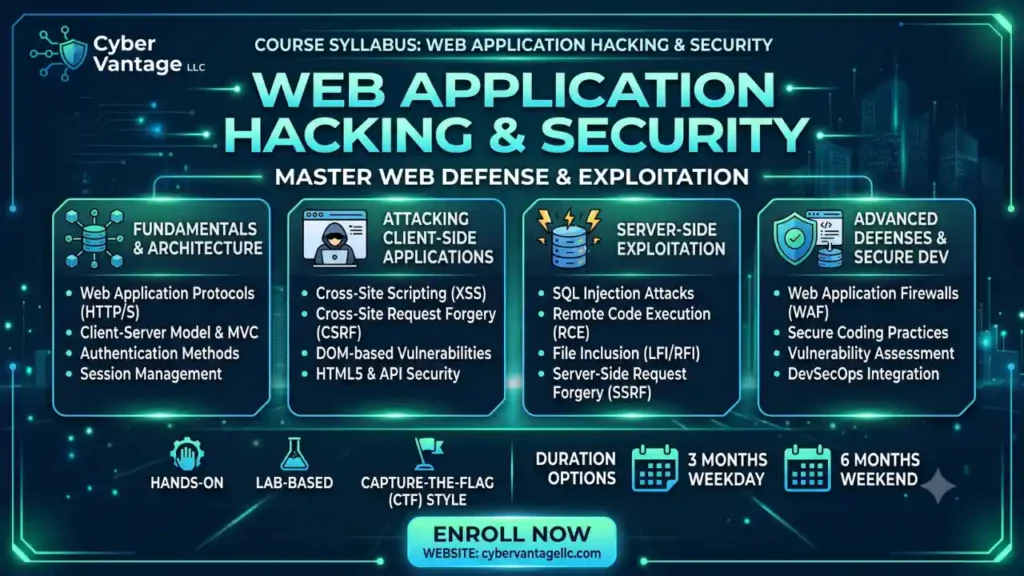
Format: Hands-On, Lab-Based, Capture-The-Flag (CTF) Style
Duration: 3 months/weekday 6months/weekend
Course Description
This complete hands-on, lab-based mastery course is designed to teach professionals how to understand, exploit, and defend against the topmost web vulnerabilities. The curriculum functions like a Capture-The-Flag (CTF) competition, challenging students to work through progressively difficult scenarios derived from advanced penetration testing environments. Participants will learn to navigate the 43,986 exploits in the Google Hacking Database and defend against the thousands of Common Vulnerabilities and Exposures (CVEs) threatening modern cloud-based apps.
Target Audience
This course is specifically designed for professionals tasked with implementing, managing, or protecting web applications.
- Penetration Testers and Ethical Hackers.
- Web Application Penetration Testers and Security Engineers or Auditors.
- Red Team Engineers and Information Security Engineers.
- Risk or Vulnerability Analysts and Vulnerability Managers.
- Incident Responders seeking pure hands-on mitigation training.
Course Objectives & Core Competencies
Upon successful completion of this program, students will be equipped to identify, exploit, and patch critical vulnerabilities, including:
- Performing advanced web application penetration testing, web app enumeration, and network scanning.
- Executing and mitigating Advanced SQL Injection (SQLi).
- Identifying Reflected, Stored, and DOM-based Cross-Site Scripting (XSS).
- Understanding Cross-Site Request Forgery (CSRF) utilizing GET and POST methods.
- Exploiting Server-Side Request Forgery (SSRF) and utilizing components with known vulnerabilities.
- Navigating Security Misconfigurations, Directory Browsing, and Bruteforcing.
- Executing CMS Vulnerability Scanning, Auth Bypass, and Dictionary Attacks.
- Implementing Insecure Direct Object Reference Prevention (IDOR) and identifying Broken Access Control.
- Exploiting Local File Inclusion (LFI), Remote File Inclusion (RFI), and Arbitrary File Download/Upload.
- Executing Command Injection, Remote Code Execution, and File Tampering.
- Identifying Privilege Escalation, Log Poisoning, and Weak SSL Ciphers.
- Performing Source Code Analysis, Cookie Modification, HTTP Header modification, Session Fixation, and Clickjacking.
Course Outline: The “Break The Code” Challenge
The course structure is driven by a progressive challenge system designed to test and elevate your hacking skills through continuous practical application. Students can earn up to 1,110 total points across four tiers:
- Beginner Tier: Features 6 Challenges, allows 60 Minutes, and is worth 60 Points.
- Intermediate Tier: Features 6 Challenges, allows 120 Minutes, and is worth 250 Points.
- Proficient Tier: Features 8 Challenges, allows 320 Minutes, and is worth 400 Points.
- Expert Tier: Features 4 Challenges, allows 240 Minutes, and is worth 400 Points.
Evaluation & Certification
To successfully complete the program, candidates must pass a rigorous assessment focused on real-world, stressful scenarios.
- Exam Format: A fully online, remotely proctored, 6-hour performance-based practical exam.
- Exam Scope: Assesses proficiencies on a broad spectrum of OWASP Top-10 vulnerabilities and attack vectors.
- Technical Requirement: Requires a deep understanding of manual exploitation techniques and web application technologies, moving beyond automated exploitation frameworks.
- Dashboard Validity: The exam dashboard remains accessible for 30 days from the time of activation.
Certification Tiers
Based on practical exam performance, students will earn one of the following credentials:
- Certified Web Application Security Associate: Awarded to candidates who score more than 60%.
- Certified Web Application Security Professional: Awarded to candidates who score more than 75%.
- Certified Web Application Security Expert: Awarded to candidates who score more than 90%.