
Table of Contents
Course Description
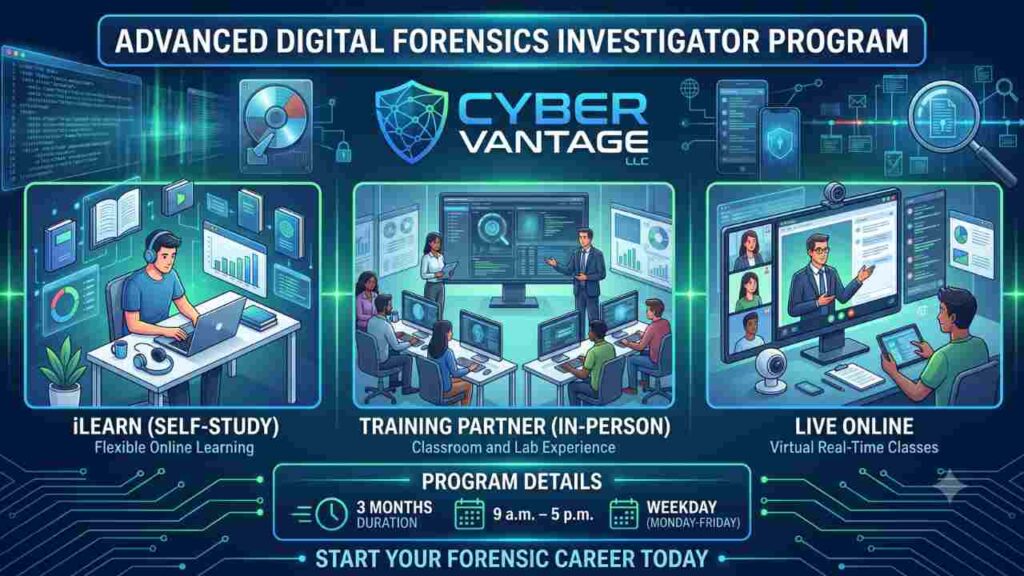
This comprehensive Advanced Digital Forensics Investigator training program immerses cybersecurity professionals in the methodologies and advanced strategies required to perform effective digital forensics investigations. The curriculum is designed to build organizational forensic readiness, focusing on search and seizure, chain-of-custody, acquisition, preservation, analysis, and reporting of digital evidence.
Institution: Cyber Vantage LLC
Duration: 3 months (9 a.m. – 5 p.m.) Weekday Monday-Friday
Format: iLearn (Self-Study), Training Partner (In-Person), or Live Online
Course Objectives
Upon successful completion of this program, students will be able to:
- Execute a methodological forensics framework (Documenting the Crime Scene, Search and Seizure, Evidence Preservation, Data Acquisition, Data Examination, and Reporting).
- Conduct volatile and non-volatile data acquisition across Windows, Linux, and Mac operating systems.
- Analyze and mitigate advanced malware threats, including the latest variants like BlackCat (ALPHV).
- Perform specialized investigations in Dark Web environments, Cloud infrastructures (AWS, Azure, GCP), and IoT devices.
- Automate digital forensics investigations utilizing Python scripting.
- Counteract anti-forensic techniques by analyzing system artifacts such as Windows ShellBags, LNK files, and Jump Lists.
Prerequisites
- Basic knowledge of IT and cybersecurity principles.
- Foundational understanding of computer forensics, incident response, and common threat vectors.
Course Outline
Module 1: Computer Forensics in Today’s World
- Fundamentals of computer forensics and the investigation process.
- Overview of cybercrimes and regulatory compliance standards influencing investigations.
Module 2: Computer Forensics Investigation Process
- Phased approaches of the forensics investigation process.
- Building forensic readiness within an organization.
Module 3: Understanding Hard Disks and File Systems
- Characteristics of different disk drives and the system booting process.
- Deep dive into Windows, Linux, and Mac file systems, RAID, and NAS/SAN storage architecture.
Module 4: Data Acquisition and Duplication
- Fundamentals of data acquisition, eDiscovery, and evidence management.
- Preparing and authenticating image files for forensic examination.
Module 5: Defeating Anti-Forensics Techniques
- Identifying attacker techniques designed to hide, manipulate, or destroy evidence.
- Applying specialized tools and countermeasures to defeat anti-forensics.
Module 6: Windows Forensics
- Volatile and non-volatile data extraction from Windows systems.
- RAM and registry analysis, Web browser forensics, and Windows Event log investigations.
Module 7: Linux and Mac Forensics
- Memory forensics and data acquisition workflows specific to Linux and Mac operating systems.
Module 8: Network Forensics
- Investigating network traffic and identifying Indicators of Compromise (IOCs).
- Event correlation and wireless attack detection processes.
Module 9: Malware Forensics
- Static and dynamic malware analysis methodologies.
- System behavior analysis and ransomware investigation.
Module 10: Investigating Web Attacks
- Understanding web application threats and attack vectors.
- Log analysis (IIS, Apache) and web attack detection workflows.
Module 11: Dark Web Forensics
- Tor browser methodology and forensic investigation of Dark Web communications.
Module 12: Cloud Forensics
- Investigating major cloud computing platforms, including AWS, Microsoft Azure, and Google Cloud.
Module 13: Email and Social Media Forensics
- Steps for investigating email crimes, tracing origins, and analyzing social media forensics artifacts.
Module 14: Mobile Forensics
- Logical and physical acquisition of Android and iOS devices.
- Analyzing cellular networks, boot processes, and SIM file systems.
Module 15: IoT Forensics
- Navigating security vulnerabilities and forensic processes for connected IoT ecosystems.
Lab Requirements and Materials
- Student Manual: Over 2,100 pages of comprehensive reading material covering theoretical and practical knowledge.
- Lab Manual: Over 1,550 pages of structured instructions outlining 68 hands-on labs.
- Simulated Evidence: Access to 70+ GB of meticulously crafted digital evidence files replicating real-world scenarios.
- Software: Utilization of over 600 modern digital forensics tools and platforms.
Evaluation & Examination
To successfully complete the program, students must demonstrate theoretical knowledge and practical capability by passing the final certification exam.
- Exam Format: Multiple choice (150 Questions).
- Exam Duration: 4 hours.
- Delivery: Administered securely via the designated EXAM Portal.