
Table of Contents
Institution: Cyber Vantage
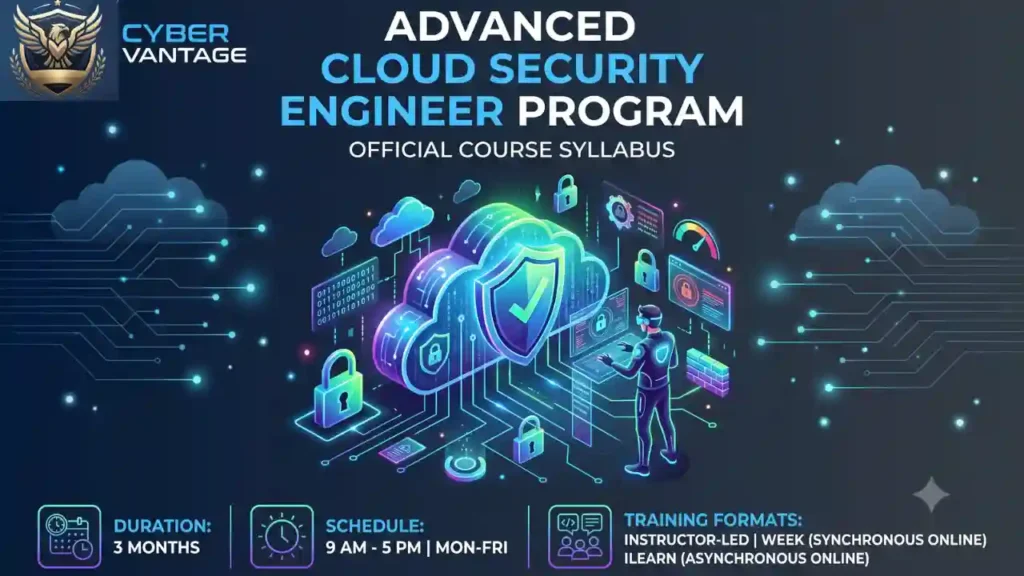
Course: Advanced Cloud Security Engineer Program
Format: Instructor-led training, Week (synchronous online learning), or iLearn (asynchronous online learning)
Duration: 3 months (9 a.m. – 5 p.m.) Weekday Monday-Friday
Course Description
This specialized program is curated by cloud security professionals in collaboration with subject matter experts to provide hands-on, methodological training in cloud security. The curriculum blends vendor-neutral best practices with vendor-specific configurations, offering comprehensive knowledge to secure major public cloud platforms, including Amazon Web Services (AWS), Microsoft Azure, and Google Cloud Platform (GCP).
Course Objectives
Upon successful completion of this program, students will be equipped to:
- Configure, plan, implement, and maintain secure cloud environments using tools and techniques for AWS, Azure, and GCP.
- Protect, detect, and respond to complex cloud security attacks in real-world threat scenarios.
- Perform comprehensive cloud computing security audits and penetration testing.
- Ensure organizational compliance with legal frameworks, standards, policies, and regulations governing multi-cloud environments.
- Utilize over 50 complex simulated labs to achieve immediate job readiness for elite cybersecurity roles.
Prerequisites
- Working knowledge in network security management.
- Basic understanding of cloud computing concepts.
Course Outline
Module 01: Introduction to Cloud Security
- Core concepts of cloud computing, service models, and cloud-based threats.
- Service provider components and the shared security responsibility model.
Module 02: Platform and Infrastructure Security in the Cloud
- Securing multi-tenant, virtualized, physical, and logical cloud components.
- Configurations and best practices for securing infrastructure using Azure, AWS, and GCP tools.
Module 03: Application Security in the Cloud
- Securing cloud applications and implementing secure software development lifecycles.
- Utilizing application security services provided by Azure, AWS, and GCP.
Module 04: Data Security in the Cloud
- Managing the cloud data storage lifecycle and implementing controls for data at rest and data in transit.
- Data storage features and security tools in Azure, AWS, and GCP.
Module 05: Operation Security in the Cloud
- Security controls for building, operating, and maintaining physical and logical cloud infrastructures.
- Operational security features and services provided by AWS, Azure, and GCP.
Module 06: Penetration Testing in the Cloud
- Implementing comprehensive penetration testing to assess cloud infrastructure security.
- Utilizing required services and tools for penetration testing in AWS, Azure, and GCP.
Module 07: Incident Detection and Response in the Cloud
- The Incident Response (IR) lifecycle and tools for identifying and responding to incidents.
- Utilizing SOAR technologies and leveraging IR capabilities in AWS, Azure, and GCP.
Module 08: Forensics Investigation in the Cloud
- The forensic investigation process, data collection methods, and navigating cloud forensic challenges.
- Investigating security incidents utilizing AWS, Azure, and GCP tools.
Module 09: Business Continuity and Disaster Recovery in the Cloud
- Importance of business continuity and disaster recovery planning.
- Implementing backup and recovery tools, services, and features provided by AWS, Azure, and GCP.
Module 10: Governance, Risk Management, and Compliance in the Cloud
- Designing and implementing governance frameworks, models, and regulations (ISO/IEC 27017, HIPAA, PCI DSS).
- Exploring compliance frameworks and the governance modules of AWS, Azure, and GCP.
Module 11: Standards, Policies, and Legal Issues in the Cloud
- Navigating standards, policies, and legal issues associated with cloud environments.
- Features and tools needed for compliance and auditing in AWS, Azure, and GCP.
Appendix (Self-Study): Private, Hybrid, and Multi-Tenant Cloud Security
- Best practices for securing VMWare Cloud, AWS, GCP, and Azure hybrid cloud setups.
- Security methodologies for multi-tenant and private cloud models.
Evaluation & Examination
To successfully achieve certification, professionals must pass a comprehensive final examination validating their technical proficiency.
- Exam Title: Certified Cloud Security Engineer
- Exam Code: 312-40
- Number of Questions: 125 (Multiple Choice)
- Duration: 4 hours
- Delivery: Administered securely via the designated Exam Portal
Thank you for taking the time to review this material. Your time and attention are greatly appreciated.